Lead scoring is a method for ranking incoming leads by how likely they are to convert, based on real behavior and fit rather than the order leads happened to arrive in. Most guides on this topic explain how to configure a scoring tool. Few explain why any of it works, what happens when a signal goes stale, or what to do if you do not have a CRM at all. This guide covers all 3.
The 2 things every lead score is actually measuring
Every scoring system, no matter how it is built, comes down to 2 kinds of signal.
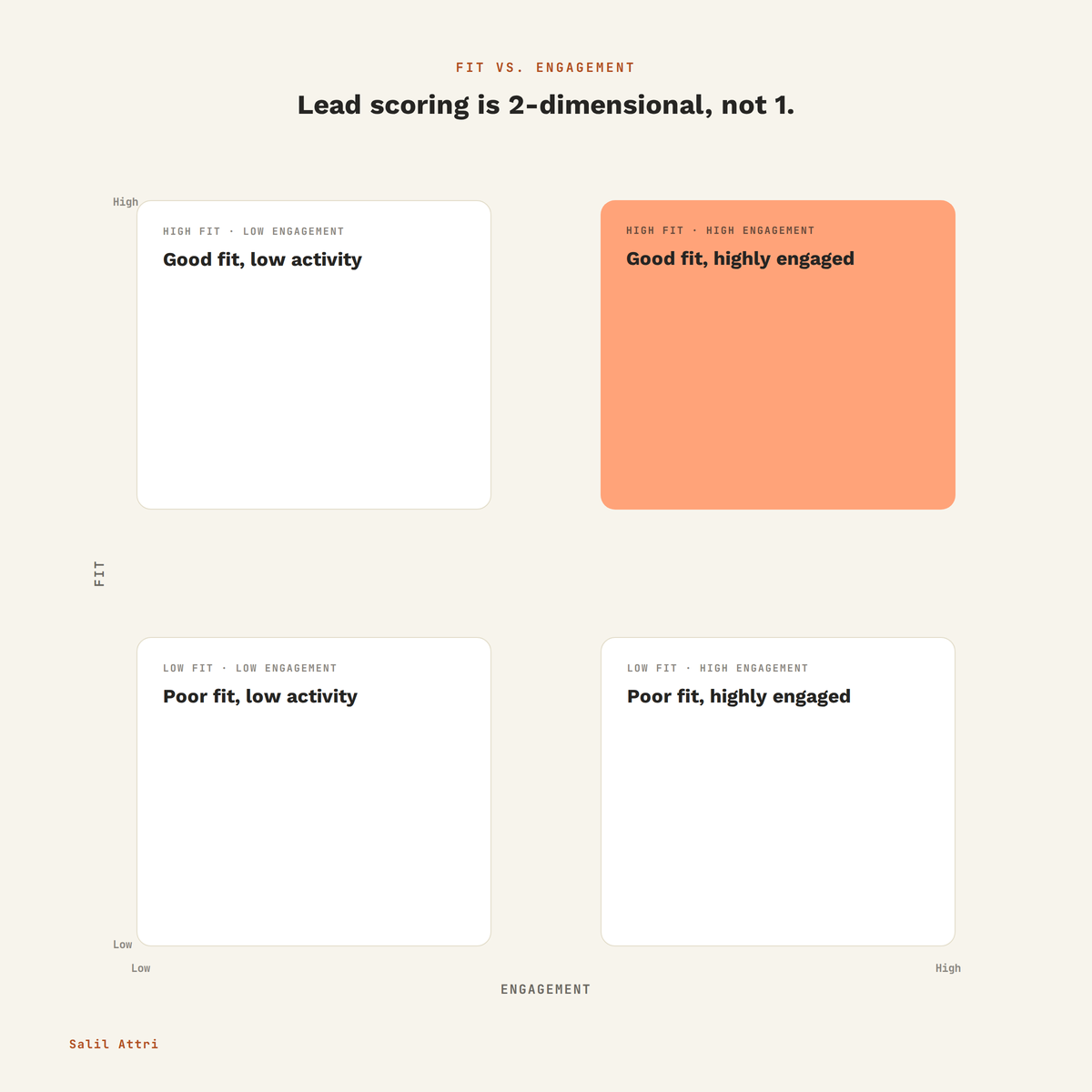
Fit asks whether this lead looks like your best customers on paper, company size, industry, job title, region. Fit tells you whether someone could be a good customer.
Engagement asks what this lead has actually done, time spent with your content, return visits, how many times they have reached out. Engagement tells you whether someone is behaving like they are close to a buying decision right now.
A lead can score high on fit and low on engagement, a perfect-looking company that has barely interacted with you. Or the reverse, someone engaging heavily who does not actually match your best-customer profile. A useful score looks at both together, rather than just 1 in isolation.
Does an old signal still count?
This is a question most lead scoring content skips entirely. A lead who spent 10 minutes on your pricing page 3 months ago is not in the same position as a lead who did the same thing yesterday. The signal happened, but its relevance fades with time.
There are 2 practical ways to handle this. Some systems reduce the value of an old event the longer it sits unactioned, so a signal from months ago counts for less than the same signal from this week. A simpler approach, and the one worth using if you do not want to manage decay curves manually, is to score based on a fixed recent window, such as return visits in the last 7 days, instead of all-time activity. This keeps the score honest about where a lead actually stands right now, rather than where they stood a season ago.
Standalone tool or the built-in scoring in your CRM?
If you already have a CRM subscription that includes native lead scoring, using it usually makes sense, since the scoring lives alongside the rest of your pipeline data. This is worth it when you have an established sales process, enough historical data to calibrate against, and a team already working inside that CRM daily.
A standalone scoring tool makes more sense in a few specific situations. You do not have a CRM yet, or the CRM you have does not include scoring on your current plan. You want a fast readiness check on a lead before deciding whether it is even worth entering into your CRM at all. You are a small or solo team that needs an answer in seconds, well ahead of a scoring model that takes a setup project to configure properly.
Neither option is universally better. The right choice depends on whether you already have the infrastructure a CRM-based score assumes.
What if you do not have historical data yet?
Some scoring approaches, particularly AI-driven ones, need a meaningful base of past data to work from, often a minimum number of converted and non-converted contacts before the system can find a reliable pattern. That is a real barrier for a new business, a new product line, or a team just starting to track leads formally.
A signal-based score does not have that requirement. It works from the first lead you ever score, since it is measuring observable behavior and stated intent rather than learning a pattern from historical outcomes. This makes it a practical starting point for teams who are not yet in a position to calibrate a predictive model, with room to move to a more data-driven approach later once enough real outcomes exist.
Where lead scoring goes wrong
Skipping the basic check before adding a scoring system at all. A scoring model built on top of incomplete or inaccurate tracking will confidently produce a wrong answer. Fix the fundamental, whether the signals are actually being captured correctly, before trusting any score that comes out of the other end.
Treating vanity signals as real signals. A page view is not engagement. A form fill with no follow-up activity is not intent. Models built around whatever data is easiest to pull, rather than what actually predicts a buying decision, tend to look precise while measuring the wrong thing.
Scoring once and letting it go stale. A score taken at a single point in time ages fast, see the section above on decay. A lead who looked lukewarm last week can be moving quickly this week, and a static score has no way of catching that shift.
Glossary
MQL (Marketing Qualified Lead) A lead that has shown enough engagement to be considered worth marketing follow-up, but has not yet been vetted by sales.
SQL (Sales Qualified Lead) A lead that has been reviewed and accepted by sales as ready for direct outreach, typically after clearing marketing qualification first.
ICP (Ideal Customer Profile) A description of the type of company and buyer most likely to become a real customer, built from real closed deals rather than an imagined persona.
TAM (Total Addressable Market) The full size of the market a business could theoretically sell into, often larger in theory than what any single team can realistically reach.
A practical starting point
I have spent 13+ years running B2B demand generation and lead qualification for SaaS, AI, and services businesses, work that has helped the teams I have worked with sustain a 3 to 4x return on marketing spend, built on getting fundamentals like this right before adding complexity on top. If you want to see the specific 8 signals I use for a fast, free readiness check, that framework is covered in The 8 Signals That Actually Predict a B2B Lead Is Ready to Buy, and you can score a real lead right now using Score My Lead, free, no CRM required.
FAQ
What is the difference between fit and engagement in lead scoring? Fit measures whether a lead matches your best-customer profile based on attributes like company size or industry. Engagement measures what a lead has actually done, such as time spent with your content or how many times they have returned. A complete score usually considers both.
Do lead scores expire? Effectively, yes. A signal from months ago carries less weight than the same signal from this week. Some systems reduce the value of a signal gradually over time, others simply score based on a recent, fixed window of activity instead of all-time behavior.
Can I do lead scoring without a CRM? Yes. A standalone tool such as Score My Lead can score a lead using the same kinds of signals a CRM-based system would use, without requiring an existing platform subscription. This works well for teams evaluating a lead before deciding whether it is even worth adding to a CRM.
Do I need a lot of historical data to start lead scoring? Not for a signal-based score. AI-driven scoring models typically need a meaningful sample of past converted and non-converted contacts to calibrate against. A signal-based score works from the first lead you score, since it measures observable behavior rather than learning from historical outcomes.