Lead scoring works when it measures real behavior instead of surface-level activity. This guide breaks down 8 signals that reliably predict whether a B2B lead is ready to buy, why each one matters, and how they fit together into a working lead qualification system. These are the exact signals used inside Score My Lead, a free lead scoring tool built around this framework.
Why lead scoring matters more than lead generation alone
Most B2B lead generation problems are actually lead qualification problems in disguise. A team can generate a steady stream of inbound inquiries and still struggle to convert them, and the reason is rarely that the leads are bad. The real cause is usually that every inquiry gets treated the same way regardless of how ready that person actually is to buy.
This is where lead scoring earns its place. Instead of following up with every lead in the order they arrived, a working lead scoring system ranks leads by real signals of intent, so the team spends its time on the leads most likely to convert first. The best lead scoring tools, whether built into a CRM or run as a standalone check, all come back to the same underlying question. What does this specific behavior actually tell you about how close someone is to a buying decision.
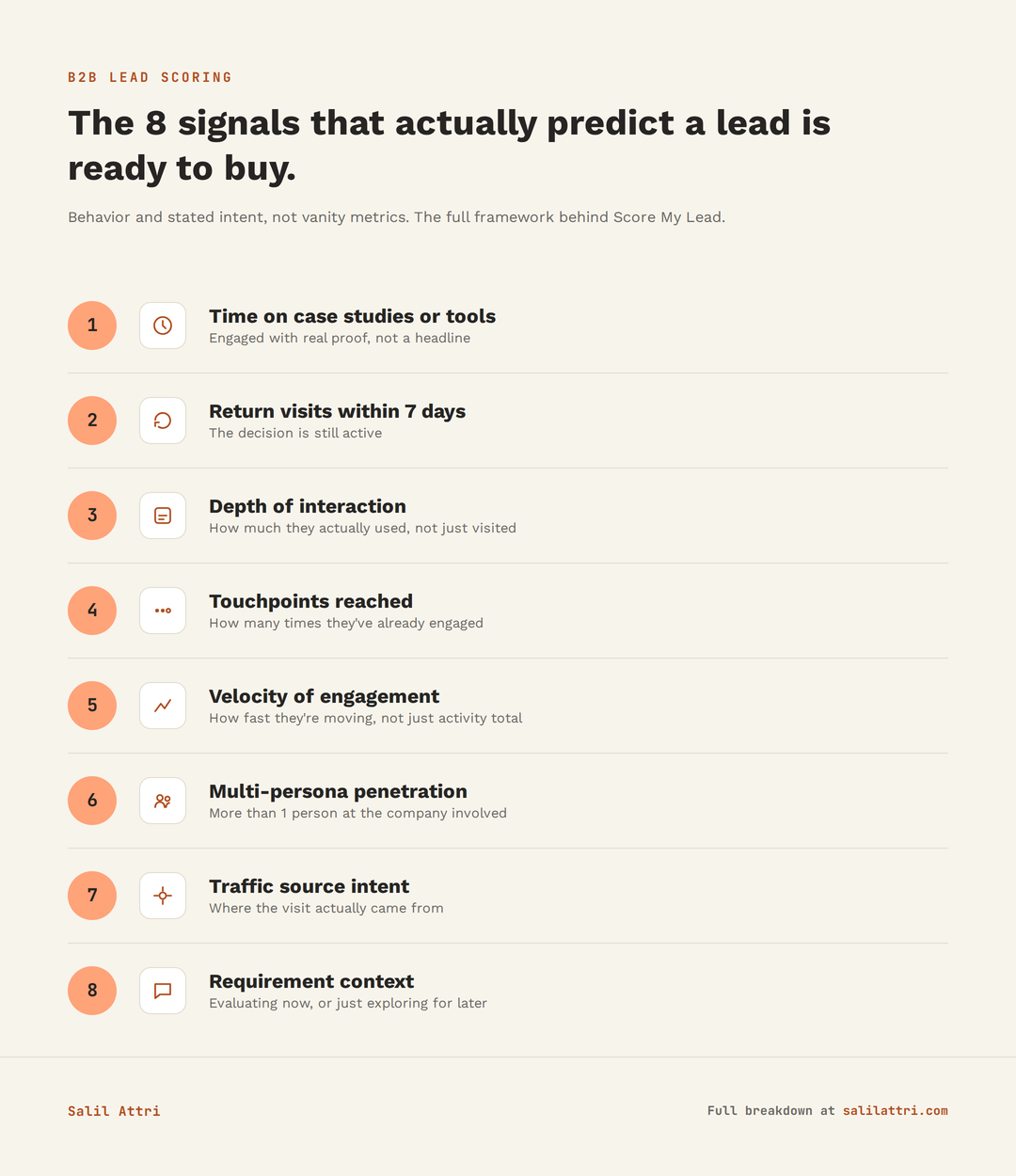
Below are the 8 signals worth tracking, and the reasoning behind each one.
1. Time on case studies or tools
What it measures: whether someone engaged with proof rather than just a headline
A page view means almost nothing on its own. Anyone can land on a page and leave within seconds without ever reading a word. Time spent with actual evidence, a case study, a demo, or an interactive tool, is a much stronger signal that someone is evaluating a solution seriously rather than passing through.
This signal matters because it separates browsing from evaluation. A lead who spends 2 minutes with a case study is doing real due diligence. A lead who bounces after 5 seconds is not evaluating anything yet, and treating both leads the same way wastes follow-up effort on the one who is not ready.
2. Return visits within 7 days
What it measures: whether the buying decision is still active
A single visit could mean curiosity. A return visit within a short window means something different, the decision has not gone cold, and the person is actively continuing their research rather than moving on.
This signal is particularly useful because it requires no prompting to observe. A lead who comes back on their own, without an email reminder or a retargeting ad pulling them back, is telling you the evaluation is genuinely still underway. That is a meaningfully stronger signal than a single, isolated visit.
3. Depth of interaction
What it measures: how much of the available content someone actually used
Landing on a page and using several resources on that page are very different levels of engagement, even though both count as a "visit" in most analytics tools. Depth of interaction looks past the visit itself and measures how much of what was offered actually got used.
Treating a skim and a deep read as the same signal is one of the most common mistakes in lead qualification. A lead who used multiple resources, a calculator, a downloadable guide, a comparison page, is demonstrating active evaluation. A lead who skimmed 1 page is not there yet.
4. Touchpoints reached
What it measures: how many times someone has already engaged with the business
B2B buyers rarely decide off a single interaction. They compare options, read reviews, and sit with a decision for days or weeks before ever reaching out directly. Counting touchpoints captures where a lead actually sits in that process.
A lead on their 3rd touchpoint has already invested meaningfully more attention than a lead on their 1st. This signal is a useful proxy for buying-cycle stage, since B2B decisions accumulate touchpoints over time rather than converting in a single session.
5. Velocity of engagement
What it measures: how fast a lead is moving through the decision, beyond whether they are engaging at all
2 leads can show identical total activity and still be in completely different positions. A lead who completed several touchpoints across 2 days is moving with real urgency. A lead who took 6 weeks to reach the same activity level is moving far more slowly, possibly toward a decision that has stalled entirely.
This is one of the more overlooked signals in lead qualification, since most scoring systems only measure whether an action happened, without capturing how quickly it happened relative to the actions before it. Velocity turns a static snapshot into something closer to a trend line.
6. Multi-persona penetration
What it measures: whether more than 1 person at the company is now involved
Real B2B buying decisions almost always involve more than 1 stakeholder before a deal closes. A single person engaging with content usually signals early, individual research. Multiple people from the same company engaging independently usually signals the buying process has moved into a more serious, organizational phase.
This signal is a strong predictor precisely because it is hard to fake. A single enthusiastic researcher does not guarantee a deal. A second or third person from the same company showing up on their own is a much harder signal to dismiss.
7. Traffic source intent
What it measures: what the origin of the visit already reveals about intent
Where a visit comes from carries real signal before a single question gets answered. Someone arriving from a direct search for a specific solution category is behaving very differently than someone who clicked a generic social post out of passing interest.
This signal works well as an early filter, since it applies the moment someone lands on the site, well before any behavioral data has had a chance to accumulate. High-intent traffic sources deserve a different starting assumption than low-intent ones.
8. Requirement context
What it measures: stated intent, directly from the lead
This is the 1 signal that does not need to be inferred from behavior, since it comes from the lead stating it directly, whether they are actively evaluating options right now or simply exploring for later. A direct statement of intent often catches what the other 7 behavioral signals miss entirely.
Requirement context works best as a confirming signal rather than a standalone one. A lead showing strong behavioral signals across the other 7 categories, who also states they are evaluating options now, is about as strong a combined signal as B2B lead qualification gets.
Putting the 8 signals together
None of these signals mean much in isolation. The value comes from combining them into a single score that reflects the full picture, rather than reacting to any 1 signal on its own. This is the exact approach used inside Score My Lead, a free tool that takes these 8 signals and returns a score out of 100, sorted into 3 tiers, Nurture, Monitor, or Priority, so a team knows who to follow up with first without guessing.
FAQ
What is lead scoring? Lead scoring is a method for ranking incoming leads by how likely they are to convert, based on real behavioral and stated-intent signals rather than the order leads happened to arrive in.
What is the difference between lead generation and lead qualification? Lead generation is about attracting inbound interest. Lead qualification is about determining which of those inbound leads are actually ready to buy. A high volume of leads with weak qualification often converts worse than a smaller volume of well-qualified ones.
What are the best lead scoring tools for B2B teams? The right tool depends on team size and budget. Larger teams already inside Salesforce or HubSpot often use the native scoring built into those platforms. Smaller teams or those without an existing CRM dependency can use a free, standalone tool such as Score My Lead to get a fast readiness check without an enterprise setup.
Can lead scoring work without a CRM? Yes. A scoring system needs access to behavioral and intent signals, which does not require a CRM specifically. A standalone tool can score a lead using the same signals a CRM-based system would use, without requiring an existing platform subscription.