The primary goal of any business is to generate leads, but it is just as important to understand the difference between lead generation and lead qualification, something already covered in an earlier article.
B2B teams are usually quite good at collecting lead data. They know who visited the website, which pages they visited, what they downloaded, and how many times they came back. Most systems then turn all of that into a single number. That is where the actual problem starts.
That number gets treated as the decision. A lead with a score of 80 is not necessarily the same as another lead with a score of 80.
For example, one person might have visited a website several times over the past 3 months while casually researching the market. Another might have visited the pricing page and gone through a case study twice in the last 3 days while actively evaluating a solution right now.
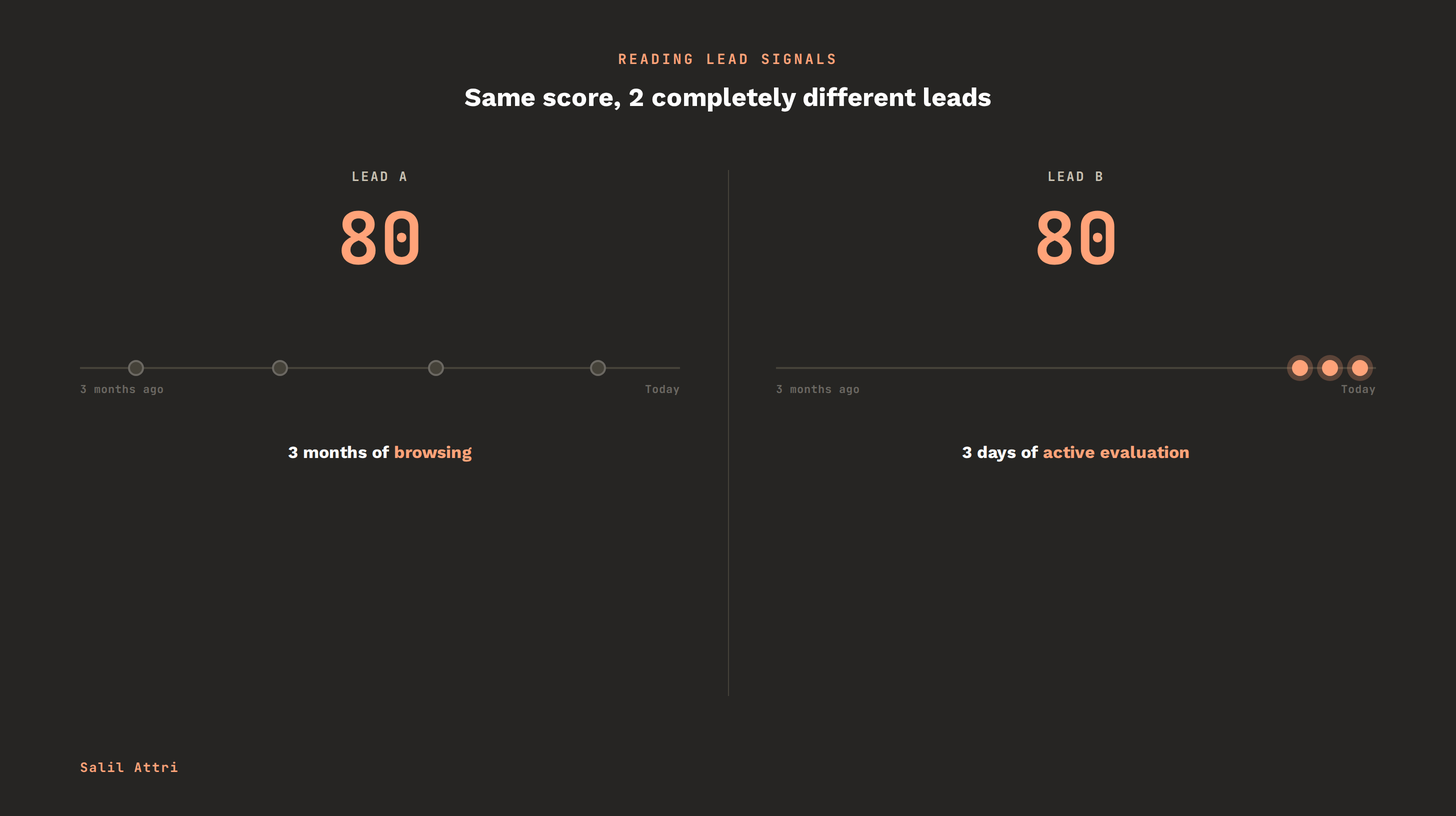
The score looks identical on screen, but the situations are completely different. This is why businesses need to spend less time looking at the score itself and more time understanding what actually created it.
What Is Lead Scoring?
Lead scoring is widely used by B2B marketing teams to identify Marketing Qualified Leads, or MQLs. On paper, the idea is simple, award points for specific activities, and once a lead crosses a certain number, it becomes an MQL. It gives sales teams a way to sort through a large volume of leads without treating everyone the same.
Lead scoring ranks contacts based on fit and engagement. Buying intent actually develops across people, topics, channels, and time. Lead scoring only captures the person who becomes visible, and it usually misses the account activity happening around them. Lead scoring works best as a starting point, one signal pointing toward where to look closer.
When Old Signals Start Losing Their Value
Not every activity carries the same value over time. An action on the pricing page yesterday says something very different than the same action 6 months ago, yet many lead scoring models treat both the same, without accounting for timing. This is where signal decay comes in.
For example, a prospect might download an industry report 8 months ago and never interact with the brand again. That download stays part of their history, but it may say little about what they are looking for today.
Compare that to a lead who visited the product page, checked pricing, and came back again within the last week. Even if both leads accumulated similar points, the second lead is giving far more recent information about their actual behavior.
This is why a useful question is not just what a lead did, but when they did it. The timing of a signal changes how useful that signal actually is.
How Fast a Lead Moves Matters Just as Much
The number of actions a lead takes matters, but the time between those actions matters just as much. This is what I call engagement velocity. One lead might visit a website, check the product page, look at pricing, and read a case study within 2 days. Another lead takes the same 4 actions but spreads them across 6 weeks.
On the surface, both leads can land on the same score, since they took the same actions. The behavior behind that score looks very different.
The first lead moved through several touchpoints in a short window. The second lead showed occasional interest spread across a much longer stretch. None of this guarantees the first lead converts.
A more useful question than "how many activities has this lead completed" is "how quickly are these activities happening." That difference gives sales real context for deciding which leads need attention first.
Your Lead's Journey May Have Started Before the Website
A lead scoring system cannot fully capture what happened before a lead became visible to the team. A prospect may have already seen a LinkedIn post, researched the product, read a review, or discussed it internally long before ever visiting the website. When they do land on the site, analytics records it as their first visit, which creates a real gap in how businesses understand the buyer journey.
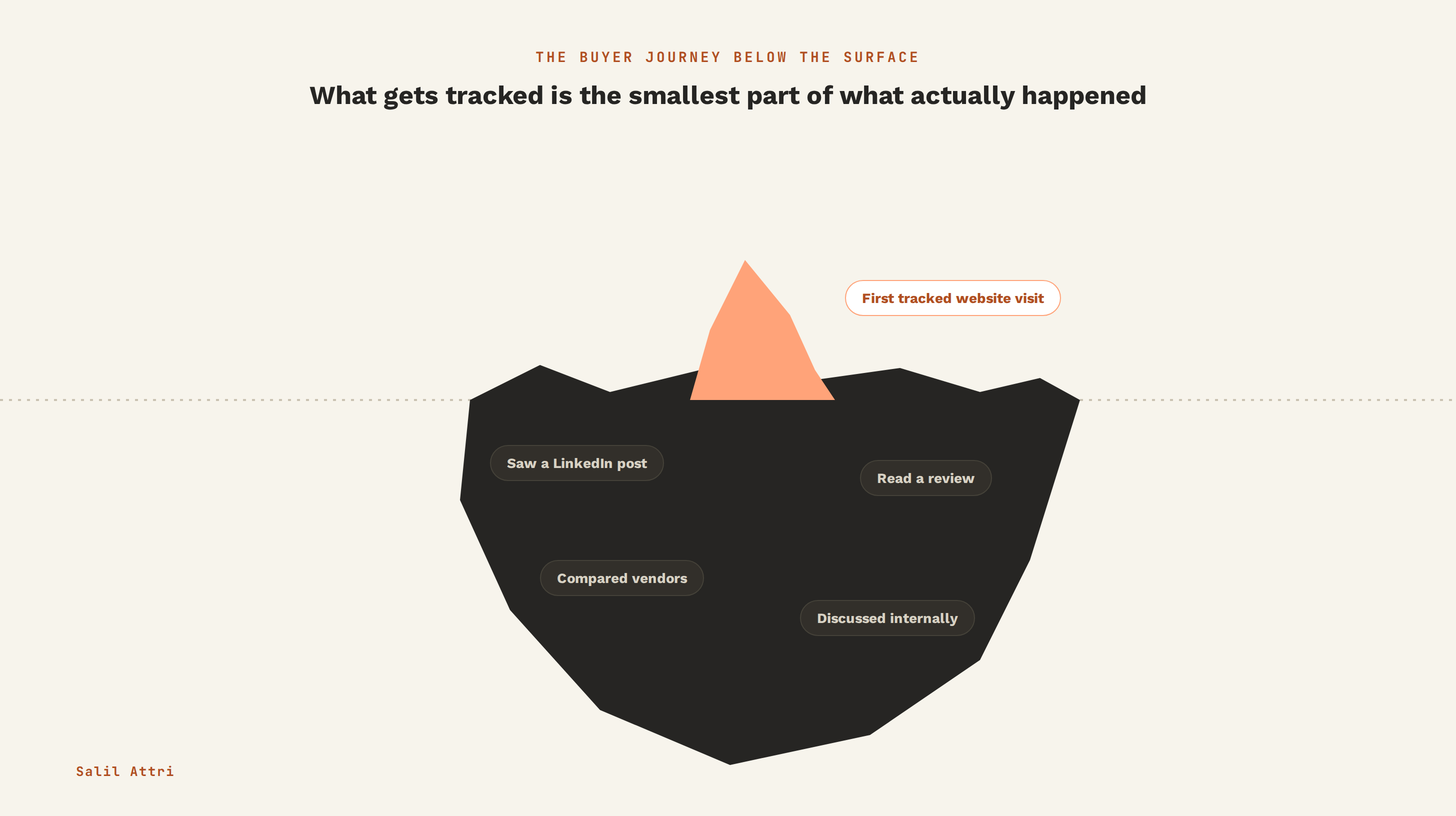
For example, a prospect visits a website and checks the pricing page. On its own, that looks like a strong signal. What is easy to miss is that they may have already been following the content for 2 months, comparing the company against 2 other vendors the whole time.
The website visit was not the beginning of their journey. It was just the first part that could actually be tracked. This is why treating the first visible activity as the start of buyer intent is risky. A lead can become visible to a system long after they first became aware of the brand.
All of this leads to another important question. Is the focus on one person, or on what is happening across the entire account?
Are You Tracking the Lead or the Whole Account?
In B2B, one person is rarely the only one involved in a buying decision, which is why looking at individual lead activity alone is not always enough. A marketing manager might visit a website first. A few days later, someone from sales downloads a case study, and another stakeholder checks the pricing page.
Looking at leads individually can miss the bigger picture. One person showing interest is one level of signal. Several people from the same company engaging with different parts of a site paints a much bigger picture.
This is where account-level activity becomes useful. It helps sales understand whether interest is limited to one person, or moving across multiple roles inside the company.
It also puts individual actions into context. A pricing page visit means something different coming from a random visitor than it does when several people from the same company are already engaging with the content.
Multiple visitors from the same company are simply one more signal that helps the sales team understand the opportunity better.
Conclusion
Lead scoring makes it easier to organize leads. The real value comes from understanding what is actually happening behind the number, when a lead engaged, how quickly they moved between touchpoints, what may have happened before the website visit, and whether other people from the same company are showing interest too. A lead score helps prioritize a list.
Context is what helps prioritize the right leads within it. The more a business understands the real behavior behind its lead data, the easier it becomes for sales and marketing to focus their time on the opportunities that actually deserve attention and turn them into real customers.
FAQ
Can a high lead score be misleading? Yes. A high score can come from many activities without reflecting real buying intent. What matters is understanding which activities created that score, and when they happened.
What is engagement velocity in lead scoring? Engagement velocity measures how quickly a lead moves between touchpoints. 2 leads can take identical actions and still show very different momentum, based purely on the time between those actions.
What is signal decay in lead scoring? Signal decay means some activities become less relevant as time passes. A recent pricing page visit usually carries more useful context than the same activity from several months earlier.
Why is account-level lead tracking important in B2B? B2B buying usually involves multiple people. Tracking activity across an account helps teams see whether engagement is limited to one person, or spreading across several roles.
Does the first website visit mean the buyer journey has started? Not necessarily. A prospect may have already seen content, attended an event, spoken with someone, or read about the company before ever visiting the website. The first trackable interaction is not always their first real interaction with the brand.