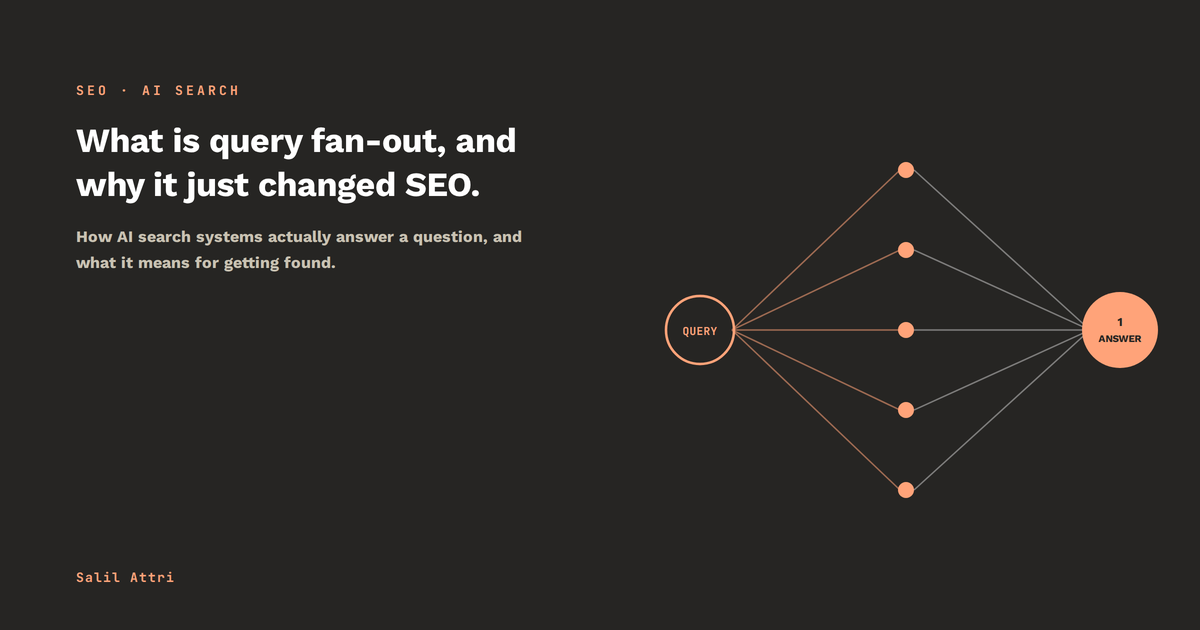
Query fan-out is the process AI search systems use to answer a question. Instead of matching your exact search phrase, the system breaks it into several related sub-queries, runs them at the same time, and combines the results into 1 answer. Google AI Mode, AI Overviews, ChatGPT, Perplexity, and Gemini all use some version of this.
What query fan-out actually is
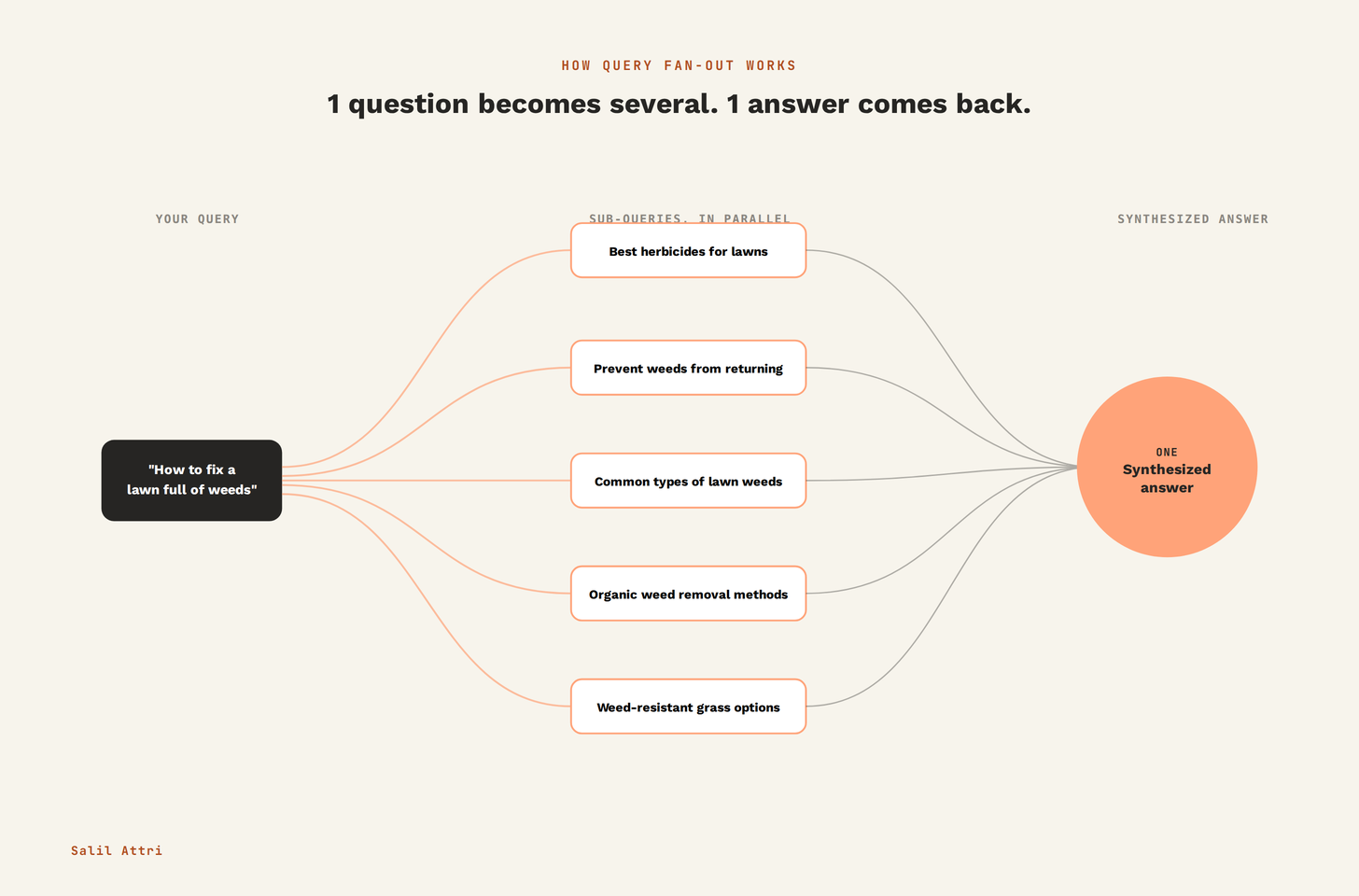
Type a question into a traditional search engine and it looks for pages matching that exact phrase. Type the same question into an AI-powered search experience and something different happens. The system decomposes the question into a set of related sub-questions, searches for each one in parallel, and synthesizes a single answer from whatever it finds across all of them.
Google has used this example in its own documentation. A search for how to fix a lawn full of weeds does not just look for that exact phrase. It fans out into related sub-queries, best herbicides for lawns, how to prevent weeds from coming back, and similar. The final answer pulls from sources across that entire set of sub-queries rather than just 1.
Why this just changed SEO
For years, the working assumption in SEO was simple. Rank in the top spots for a keyword, and you get the clicks. That assumption no longer holds the same way once an AI system is doing the searching for the person instead.
Research analyzing over 170,000 URLs found that a majority of pages cited inside AI Overviews were not sitting in the top 10 organic results for the visible query. A page could rank lower for the exact phrase someone typed and still get cited, simply because it answered 1 of the sub-queries the AI system generated behind the scenes particularly well.
On May 15, 2026, Google published its first direct guidance addressing this shift, confirming that its AI Overviews and AI Mode features are built on the same core ranking and quality systems as traditional search. The fundamentals have not changed. What changed is the surface. Ranking for a single keyword is no longer the same as being visible, since visibility now depends on covering the full space of questions someone might actually be asking around a topic.
What this means practically
Covering a topic thoroughly now matters more than optimizing narrowly for 1 keyword. A few practical shifts follow from that:
- Structure content around real sub-questions instead of just the main keyword, using clear headers phrased the way someone would actually ask.
- Put the direct answer near the top of each section, before the supporting detail, so an AI system has a clean passage to extract.
- Use comparison tables, specific numbers, and dated facts where relevant, since these tend to get extracted more reliably than vague prose.
- Freshness appears to matter more than it used to. Research from Ahrefs found that pages cited by AI tools tend to be noticeably more recently updated than the pages typically surfacing in traditional search results.
None of this replaces the fundamentals of good SEO, a fast site, clear structure, real expertise. It adds a new layer on top, whether your content actually answers the full set of questions an AI system generates around a topic, beyond just the 1 question someone typed.
A tool idea I am exploring
I am currently exploring an early concept for a tool called Query Fanout Finder, something that would show the likely sub-queries an AI system generates around a given topic or keyword, so a content plan can be built around the full question set instead of guessing. This is still at the validation stage, still unbuilt. If this is a problem you run into regularly, I would genuinely like to hear about it.
FAQ
What is query fan-out in SEO? Query fan-out is the process AI search systems use to break a single search into multiple related sub-queries, retrieve results for each one, and combine them into 1 synthesized answer.
Which platforms use query fan-out? Google AI Mode and AI Overviews both use versions of this process, alongside AI assistants such as ChatGPT, Perplexity, and Gemini.
Does ranking number 1 still matter? Ranking well is still part of the foundation, since it affects whether a page enters the pool of candidates an AI system can pull from. It is no longer the only factor, since a page can rank outside the top 10 for the visible query and still get cited if it answers a specific sub-query clearly.
How is this different from regular SEO? The fundamentals stay the same, technical health, real expertise, useful content. What changes is the target. Traditional SEO optimizes for 1 keyword. Content built for query fan-out needs to answer the full set of related sub-questions an AI system might generate around that same topic.